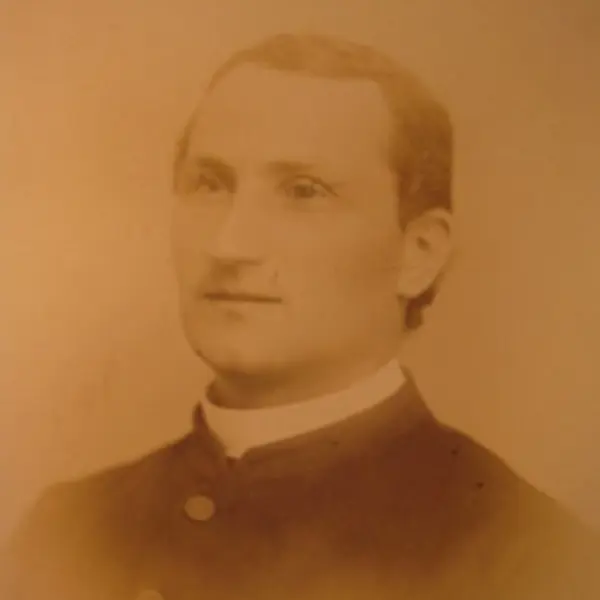
He was also a “great spiritual writer”: “On February 21, 1932, the Company of Saint-Sulpice lost one of its great spiritual writers of the early 20th century, Adolphe Tanquerey,” notes the Sulpician Fathers’ website. Born in Blainville-sur-Mer (France) in 1854, he entered the seminary of Coutances (1873–1875) before joining the Saint-Sulpice Seminary in Paris, and he was ordained a priest in 1878. He entered the Company of Saint-Sulpice the following year. He was sent to Rome to continue his theological studies at the Dominican Angelicum, specializing in Thomistic theology and canon law. He then taught in Nantes and at the seminary of Rodez (1879–1887).
Adolphe Tanquerey, PSS (1854–1932),
Compendio di teologia ascetica e mistica,
Cinisello Balsamo, San Paolo Edizioni, 2018 (Italian edition).

In 1887, he was appointed professor in the United States, as he was recognized “as a Frenchman open to acquiring English and capable of adapting to another way of approaching the formation of priests in the New World.” Soon Father Tanquerey became a faculty member at the seminary and at Saint Mary’s University in Baltimore, Maryland. It was the first seminary in the United States, founded in 1791. During this period (1887–1902), he developed his abilities as a theologian and wrote numerous works in spiritual and mystical theology, moral theology, and dogmatic theology. In 1902, he returned to France as a lecturer at Saint-Sulpice. He also served as superior of the Saint-Sulpice Seminary.
Clarity and Rigor
His many publications became models of “theological manuals.” They were widely used in both France and the United States for the basic theological formation of seminarians, up until the Second Vatican Council. Among Tanquerey’s most significant works, the Saint-Sulpice website mentions the treatise presented by the Pope to his collaborators, as well as A Manual of Dogmatic Theology (2 volumes, reprinted until 1959), A Brief Synopsis of Moral and Pastoral Theology (2 volumes, 1902), and De Virtute Justitiae (1905). These books were appreciated “for their clarity, their rigorous structure, and the remarkable ease with which Catholic theology was presented.”
Tanquerey’s manual includes an “Introduction” on the foundations of ascetical and mystical theology, followed by a “First Part” developing the principles of Christian spiritual life, and a “Second Part” offering an ordered presentation of the progress of Christian life, according to the Italian edition. It is not simply a “manual,” but rather a “compendium,” that is, a sufficiently complete yet concise summary of each question and subject. Its purpose is to recall immediately what is essential to know, both in the area of Christian asceticism and in abandonment to grace in the mystical life.
Progress in Love
As the publisher also emphasizes, his work is marked “by the idea of progress” in the spiritual life—of struggle, authentic trust in grace and in the ordinary means of benefiting from it, as well as the courage to embrace complexity against simplistic reductionism. It also reflects a deep awareness of the constant presence of God’s light in the human heart.
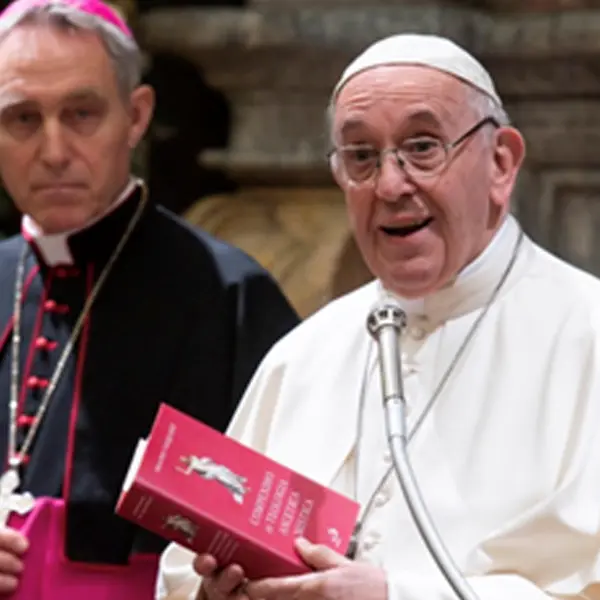
Thus, this was the Christmas gift of Pope Francis to his collaborators: he does not hesitate to say, following Benedict XVI, that there are “saints” among them. But he also adds, in that same address to the Roman Curia, this warning: “Often, even the chosen, along the way, begin to think, believe, and behave like masters of salvation rather than its beneficiaries, like controllers of the mysteries of God rather than humble dispensers, like customs officers of God rather than servants of the flock entrusted to them.” “Often,” the Pope continues, “through excessive and misguided zeal—rather than following God—we place ourselves ahead of Him, like Peter (…).”
The Pope emphasizes that progress is inherent to the gift received: “Salvation is a gift (…) which must be welcomed, safeguarded, and made fruitful.” He therefore offers this “compendium” to help foster this progress in love of Christ and of neighbor.
On the feast of Saint Marie of the Incarnation, April 30, 2025
Fr. Jean-Pierre Lussier, PSS
(Pope Francis, Christmas Greetings to the Roman Curia, December 21, 2018)